
Christian Wolff's Elements Are Not Identical to Leibniz's Monads

In my post Leibniz's Monads: Infinitesimals of Consciousness, I studied Gottfried Wilhelm Leibniz’s (1646-1716) monads, and ultimately concluded that they could be considered to be “infinitesimals of consciousness”. This is what I wrote:
So I think that with this cursory look at the monads, I can conclude that the late Leibniz tends towards idealism, and considers the material world to be a phenomenon of the ideal world, made up of an eternal, infinite set of living, conscious monads. Given that these monads have no extent, and given that Leibniz developed the calculus through the use of infinitesimals, I think it is appropriate to consider the monads to be infinitesimals of consciousness. It will be interesting to see how Leibniz’s monads influenced the thoughts of successive researchers. [my emphasis]
The most important immediate successor for Leibniz was Christian Wolff (1679-1754). So I set myself to figure out what Wolff’s elements correspond to. It was not obvious, but after reading a number of papers, I realized that the foremost expert on Wolff’s metaphysics was Jean École, the principal editor of Wolff’s collected works. After much searching, I was able to get a copy of École’s La métaphysique de Christian Wolff1 [The Metaphysics of Christian Wolff] from Celler Versandantiquariat in Eicklingen, near Hannover.
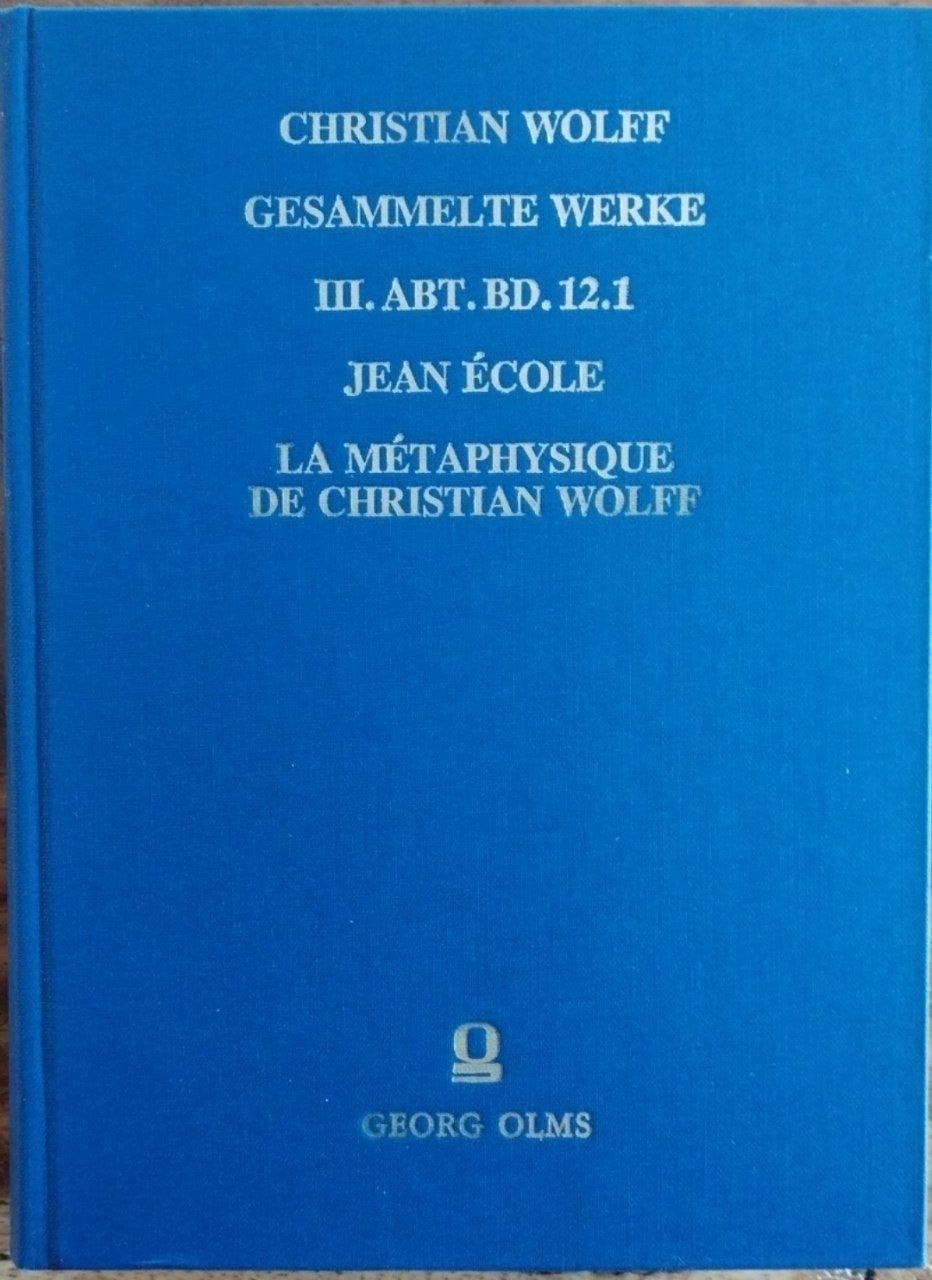
Much to my delight, I found that there was therein a inscription for the publishers signed by Jean École himself.
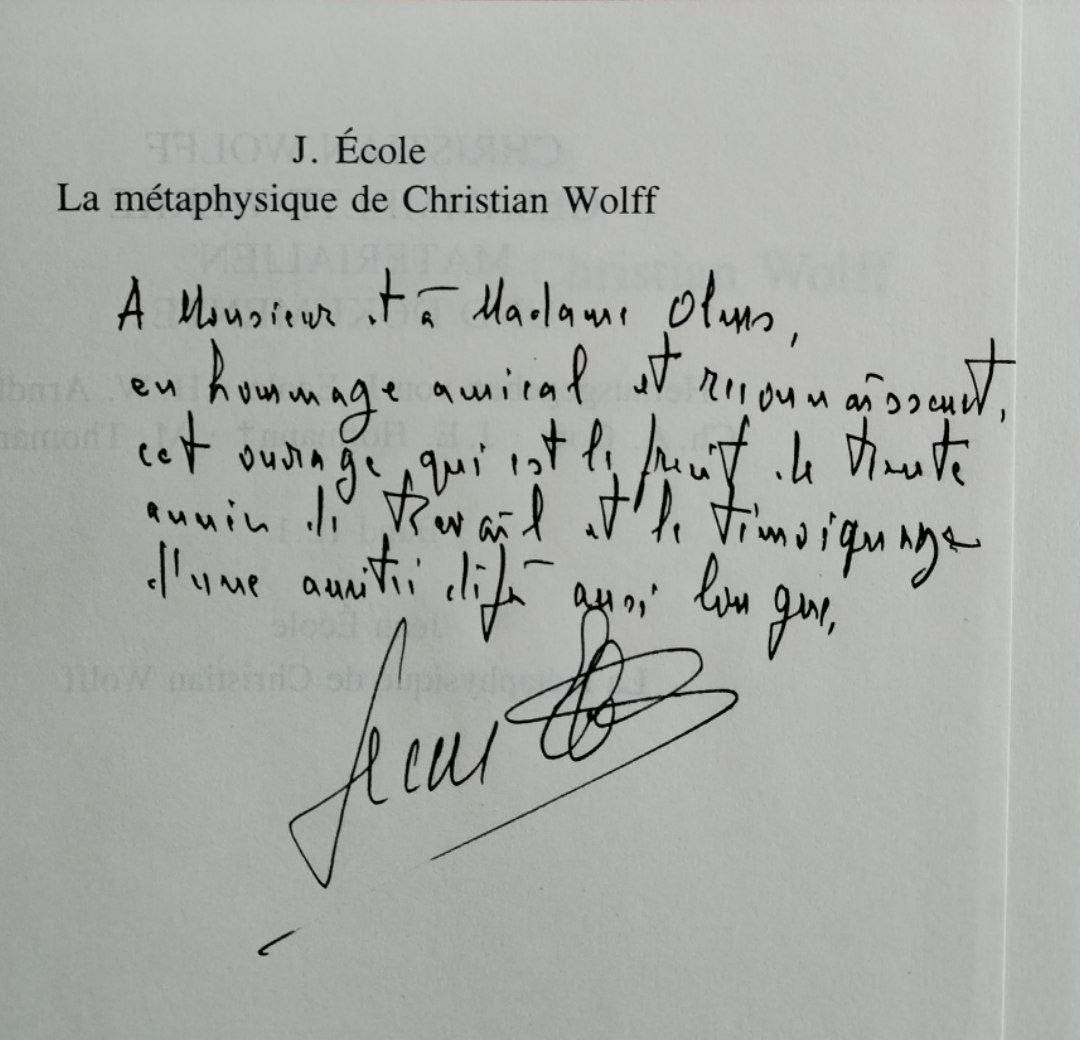
À Monsieur et Madame Olms, en hommage amical et reconnaissant, cet ouvrage qui est le fruit de trente années de travail et le témoignage d’une amitié déjà aussi longue. Jean École.
To Mr and Mrs Olms, as a token of my friendship and gratitude, I dedicate this book, which is the fruit of thirty years’ labour and a testament to a friendship that has already lasted just as long. Jean École.
And now I can start thinking about the text. Wolff, like Leibniz, wrote about a huge variety of topics. In this post, I will only focus on his elements, or simple substances. In École’s book, these are covered in Part IV: The theory of the world in general, Chapter III: The components of the world, Section II: The elements [pp.238-241]. The quoted passages are translated into English from a mixture of École’s French and Wolff’s Latin, with the originals in footnotes.
An element is defined to be a simple substance, which cannot be further subdivided.
1. Wolff refers to these simple substances as ‘elements’, defining the term as follows: ‘the internal principle of bodies, which cannot be reduced to another, nor to the first’, to which he adds the following commentary: ‘We understand here the principle of the existence of bodies, which contains within itself the reason for their possibility…, or from which it is understood why bodies are possible… It is called irreducible because it does not depend on any prior principle’.2
The elements do not have extent:
3. Owing to their simplicity, these elements are not extended; they have neither configuration nor magnitude, do not occupy any space, are not subject to internal motion, and are indivisible.3
They elements are not the atoms either of Epicurus or Leucippus. [I have previously written about the ancient Atomists in my post Lucretius's Of the Nature of Things: Atoms and the Void]:
4. Nor, therefore, can they be confused with Epicurus’ atoms, which, whilst being indivisible due to their hardness, are nevertheless small bodies endowed with a configuration by which they differ from one another; nor with those of Lucretius, who attributes to them a massive simplicity excluding any composition of parts, but does not deny that they form a homogeneous and coherent whole of irreducible particles.4
So Wolff’s elements, like Leibniz’s monads, can be considered to be ‘Atoms of nature’, using Leibniz’s term, as opposed to the material atoms of Epicurus or Leucippus:
If, therefore, one wishes nevertheless to call these elements ‘atoms’, it must be made clear that they are what Leibniz termed ‘atoms of nature’, in order to distinguish them from the material atoms of the two preceding authors.5
But it would be a mistake—as was made by Johann Joachim Lange [1670-1744]—to equate Wolff’s elements and Leibniz’s monads, because the elements are physical, not metaphysical, endowed with their own internal vis activa [living force, now understood as kinetic energy]:
5. Now, it is well known that Leibniz used this expression to refer to his monads, which he regarded as ‘the elements of things’. But the identity of the terms must not be misleading. Wolff, in fact, does not subscribe to monadism. He states quite unequivocally: ‘I leave it to Leibniz to deal with his doctrine of monads… For it matters little to me whether Leibnizian monads are held in high esteem or condemned and rejected’, and he returns to this point on several occasions. Whilst his elements share with Leibnizian monads the characteristic of being perfectly simple substances, they are not, like them, ‘metaphysical points … [which] possess something vital and a kind of perception’, which, moreover, are one and the same as the vis activa primitiva, but rather physical units endowed with a vis activa that is itself physical, with which they are not identical and which are not capable of perception; hence, they could be called physical atoms.6 [my emphasis]
Finally, the elements are not the points of Zeno of Elea [c.490-c.430 BC], since the elements are all different from one another:
6. Wolff’s elements differ not only from the material atoms of the Atomists and Leibniz’s monads, but also from Zenonian points. For whilst the latter are simple entities, they possess no intrinsic determination other than the absence of parts and are mathematical points, all alike. However, apart from regarding them as physical points, Wolff attributes to his elements, amongst other properties, that of being all dissimilar.7
In my post about Leibniz’s monads, I wrote that Leibniz’s understanding of the relation between his monads and the material world was never fully clarified, even leading to an “extensive correspondence [over 500 pages] that took place between Leibniz and the Jesuit Bartholomaeus Des Basses, who translated the Theodicy from French into Latin.”
Similarly, for Wolff, the relationship between his elements with no extent and material bodies that do have extent is not clear:
2. As regards extension, the elements certainly do not possess it, as we have said. But we know that extension consists of the union of different coexisting beings, that is to say, ‘existing independently of one another’. Now, whilst this is not the case with Zenonian points, the elements that unite to form bodies are all dissimilar; otherwise, one could not explain why some constitute one body and others another; furthermore, they possess within themselves the reason for their union; otherwise, this would be a ‘pure chance’; and from this union, therefore, both the extension and the continuity of their aggregates—which are bodies—can arise. In short, extension results from that which is not extended. This may seem paradoxical, but, according to Wolff, it presents no greater difficulty than the emergence of the multitude from unity.8 [my emphasis]
In order for bodies to be capable of doing anything, their elements need to possess internal forces and powers:
3. If the elements are not extended, they must, on the other hand, possess a force of inertia and an active force, a passive power and an active power; otherwise, one could not explain those powers which must be assumed to exist in bodies in order to account for everything that takes place within them. Wolff establishes this for the force of inertia, the active force and the active power, but does not bother to do so for the active power, no doubt because it is evident that it is the primary condition of action, just as the passive power is that of passion.9 [my emphasis]
As for the forces within bodies, these arise as phenomena from the forces within their elements:
However, because we do not perceive clearly how extension arises from them, nor how the forces of bodies result from their force of inertia and their motive force, we perceive both only in a confused manner. And this is why Wolff describes them as phenomena, specifying that by this he means—unlike the Idealists (and he is no doubt referring to Berkeley)—‘that which merely appears to exist has no reality outside the mind’, but, following Goclenius, ‘everything that presents itself to the senses is perceived in a confused manner’. In other words, matter and the motive force of bodies are, for him, what Leibniz called ‘well-founded phenomena’, and he claims that Leibniz regarded them as such.10 [my emphasis]
Because of the forces within the elements, their internal state is constantly changing:
1. Because the active force of the elements, like any force of this kind, consists in a continual tendency towards change, and since nothing within them opposes this tendency owing to their simplicity, their internal state is constantly changing. Now, this change takes place in such a way that the present state of an element is always the cause of the next, and that its successive states form a series within which they are all mutually dependent in terms of their existence; from which it follows that, from the present state of an element, one can infer what its future state will be and what its past state was. Because all elements are dissimilar, the sequence of changes in the state of one element differs from that of another, and the state of one element is at all times different from that of another.11 [my emphasis]
Finally, the elements never exist separately, but combine for form bodies:
2. Elements do not exist in a separate state; they unite to form bodies. Because they possess within themselves the reason for their coexistence, they are all linked to one another within these bodies, and every state of each element stands in relation to those of the other elements that coexist with it within the same body.12 [my emphasis]
From the above discussion, it seems to me that the physical world is of more importance to Wolff than it is to Leibniz. Yet, Wolff’s elements have no extent. I had described Leibniz’s monads as “infinitesimals of consciousness”. For Wolff’s elements, I think the term “infinitesimals of physicality” is appropriate. Each has focused on an integral part of reality, but neither has provided an overarching whole.
In addition to being an important philosopher, Wolff was also the teacher of the Russian polymath Mikhail Vasilyevich Lomonosov (Михаил Васильевич Ломоносов, 1711-1765), founder of Moscow State University, who first proposed a law of mass conservation during combustion. I will soon be looking at the different ideas of atomism of the early chemists, including Robert Boyle (1627-1691), Lomonosov and Antoine Lavoisier (1743-1794).
If you wish to donate to support my work, please use the Buy Me a Coffee app.
Jean École. La métaphysique de Christian Wolff. In Christian Wolff, Gesammelte Werke, Materialien und Dokumente. Herausgegeben von J. École, H. W. Arndt, Ch. A. Corr, J. E. Hofmann, M. Thoman, Band 12.1.I, Hildesheim: Georg Olms, 1990.
Ces substances simples, Wolff les appelle éléments, en donnant de ce terme la définition qui suit: «principium internum corporum irresolubile in alia, sive primum» et à laquelle il ajoute ce commentaire: «Intelligimus hic principium essendi corporum, quod in se continet rationem possibilitatis eorundem …, seu unde intelligitur, cur corpora possibilia sint … Dicitur autem irresolubile, quia ab aliis se prioribus non pendet».
En raison de leur simplicité, ceux-ci ne sont pas étendus, ils n’ont ni configuration, ni grandeur, ne remplissent aucun espace, ne sont pas affectés de mouvements internes et sont indivisibles.
Aussi ne peut-on les confondre avec les atomes d’Épicure, qui, tout en étant indivisibles en raison de leur dureté, sont cependant de petits corps doués d’une configuration par laquelle ils se différencient les uns des autres, pas plus qu’avec ceux de Lucrèce qui leur attribue une simplicité massive excluant toute composition de parties, mais ne nie pas qu’ils sont un ensemble homogène et cohérent de particules irréductibles.
Si donc on veut malgré tout appeler atomes les éléments, il faut préciser qu’il s’agit de ce que Leibniz dénommait «Atomes de la nature», afin de les distinguer des atomes matériels des deux précédents auteurs.
Or l’on sait que Leibniz se servait de cette expression pour désigner ses monades qu’il considérait comme «Les Elemens des choses». Mais l’identité des termes ne doit pas faire illusion. Wolff, en effet, n’adopte pas le Monadisme. Il déclare on ne peut plus nettement: «Leibnitio suam de monadibus sententiam relinquo … Mihi enim perinde est, sive quis monades Leibnitianas maximi faciat, sive eas damnet atque rejiciat», et il revient sur ce point à différentes reprises. Si ses éléments ont en commun avec les monades leibniziennes d’être des substances parfaitement simples, elle ne sont pas comme elles des «points metaphysiques … [qui] ont quelque chose de vital et une espece de perception», qui de plus ne font qu’un avec la vis activa primitiva, mais des unités physiques douées d’une vis activa elle-même physique, avec laquelle elles ne s’identifient pas et qui ne sont pas capables de percevoir, d’où suit qu’on pourrait les appeler atomes physiques.
Différents des atomes matériels des Atomistes et des monades de Leibniz, les éléments de Wolff le sont encore des points zénoniques. Car si ceux-ci sont des êtres simples, ils ne comportent autre détermination intrinsèque que l’absence des parties et sont des points mathématiques tous semblables. Or, outre qu’il tient pour des points physiques, Wolff attribue à ses éléments entre autres propriétés celle d’être tous dissemblables.
En ce qui concerne l’étendue, les éléments n’en sont certes pas dotés, nous l’avons dit. Mais nous savons qu’elle est constituée par l’union d’êtres coexistants différents, c’est-à-dire «extra se invicem existentium». Or, si tel n’est pas le cas des points zénoniques, les éléments qui s’unissent pour former les corps sont, ceux, tous dissemblables, sans quoi on ne pourrait expliquer pourquoi les uns constituent tel corps, les autres tel autre corps; ils ont de plus en eux-mêmes la raison de leur union, sinon celle-ci serait un casus purus; et de cette union peuvent donc naître l’étendue ainsi que la continuité de leurs agrégats que sont les corps. En un mot l’étendue résulte de ce qui n’est pas étendu. Cela peut paraître paradoxal, mais ne soulève pas plus de difficulté, selon Wolff, que la naissance de la multitude à partir de l’unité.
Si les éléments ne sont pas étendus, ils doivent par contre posséder une force d’inertie et une force active, une puissance passive et une puissance active, sous peine qu’on ne puisse expliquer celles qu’il faut supposer dans les corps pour rendre raison de tout ce qui se passe en eux. Wolff l’établit pour la force d’inertie, la force active et la puissance active, mais ne prend pas la peine de le faire pour la puissance active, sans doute parce qu’il est évident qu’elle est la première condition de l’action comme la puissance passive l’est de la passion.
Mais, parce que nous ne percevons pas distinctement comment naît l’étendue à partir d’eux, ni comment résultent à partir de leur force d’inertie et de leur force motrice celles des corps, nous ne percevons aussi l’une et les autres que confusément. Et c’est pourquoi Wolff les qualifie de phénomènes, en précisant qu’il entend par là, non pas comme les Idéalistes — et sans doute vise-t-il Berkeley — «id, quod tantum existere apparet, nihil vero realitatis extra mentem habet», mais avec Goclenius «quicquid sensui obvium confuse percipitur». Autrement dit, la matière et la force motrice des corps sont, pour lui, ce que Leibniz appelait des «phaenomena bene fundata», et il prétend que celui-ci les tenait pour tels.
Parce que la force active des éléments, comme toute force de ce genre, consiste dans une tendance continuelle au changement et qu’en eux rien ne s’oppose à elle en raison de leur simplicité, leur état interne change sans cesse. Or ce changement s’effectue de telle sorte que l’état présent d’un élément est toujours la cause du suivant et que ses états successifs forment une série au sein de laquelle ils dépendent tous les uns des autres quant à l’existence; d’où suit qu’à partir de l’état présent d’un élément on peut inférer quel sera son état futur et quel a été son état passé. A cause de la dissemblance de tous les éléments, la série des changements d’état de l’un est différente de celle d’un autre et l’état d’un élément est à tous moments différent de celui d’un autre.
Les éléments n’existent pas à l’état séparé; ils s’unissent pour former les corps. Parce qu’ils ont en eux-mêmes la raison de leur coexistence, ils sont tous liés les uns aux autres dans ces corps et tout état de chaque élément entretient une relation avec ceux des autres éléments qui coexistent avec lui dans un même corps.