
Electric Charges Move Differently in Conductors and Insulators

This is the fifth post inspired by the two volumes of André Assis’s The Experimental and Historical Foundations of Electricity.1 The previous posts are:
André Assis on The Experimental and Historical Foundations of Electricity: I have translated these works into French and Spanish, and we are now looking to publish the translations.
Charles du Fay Discovers Vitreous and Resinous (Positive and Negative) Electricity: The discovery of electric repulsion, and of positive and negative electricity, by Charles François de Cisternay du Fay (1698-1739).
Is a Wooden Broom Handle an Electric Conductor or Insulator? Many materials are insulators at low voltage and conductors at high voltage.
The Triboelectric Series Is Not Simple: When two materials are rubbed together, which will become positive, which negative? The answer is not trivial.
This post focuses on how electric charges, positive and negative, move differently in conductors and insulators. Now, as was outlined in the third post above, it should be remembered that the terms “conductor” and “insulator” are relative, i.e., the same material can act either as a conductor or as an insulator, depending on changed external conditions. At low voltages, most materials act as insulators, while metals act as conductors; at high voltages, as occur in a lot of electrostatic experiments, most materials act as conductors, while plastics and rubber mostly act as insulators.
To introduce this topic, an experiment needs to be set up, illustrated in the figure below. A large circular disk is insulated from the ground by a set of plastic straws placed vertically to support the disk and insulate it from the ground. The straws are anchored in a base, say, made of small plastic coffee cups filled with plaster. On the disk are placed in a line three neutral charge collectors called Coulomb proof planes, numbered from left to right as 1, 2, 3, each of which is composed of a small conducting disk and an insulating handle, say a small cardboard disk and a plastic straw. A negatively charged plastic straw is placed near the large disk, in the same line as the three proof planes, and next to plane 1.
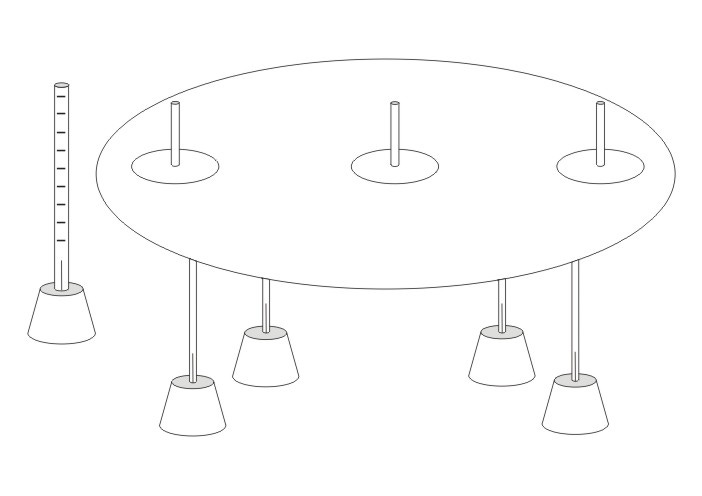
So what happens to each of the proof planes? It turns out that it depends on whether the large disk is a conductor or an insulator. For example, if the large disk is made of cardboard, it will act as a conductor, and if it is made of plastic, it will act as an insulator. So how do these differ? That is the purpose of the proof planes: each in turn is tested for its charge by picking it up by its insulating handle and approaching it, first to a positively charged electroscope, then to a negatively charged electroscope. Should the proof plane attract (repel) the positively charged electroscope and repel (attract) the negatively charged electroscope, then the proof plane will be declared to be negatively (positively) charged. We consider the two cases:
In the first case, where the large disk is a conductor, say a large sheet of cardboard, then proof plane 1 will be positively charged, proof plane 2 will be neutral, and proof plane 3 will be negatively charged.
In the second case, where the large disk is an insulator, say a block made of plastic, then all of the proof planes will remain uncharged.
So what is the difference between the two cases? The difference lies in the electric polarization induced in the cardboard disk (conductor) and in the plastic disk (insulator).
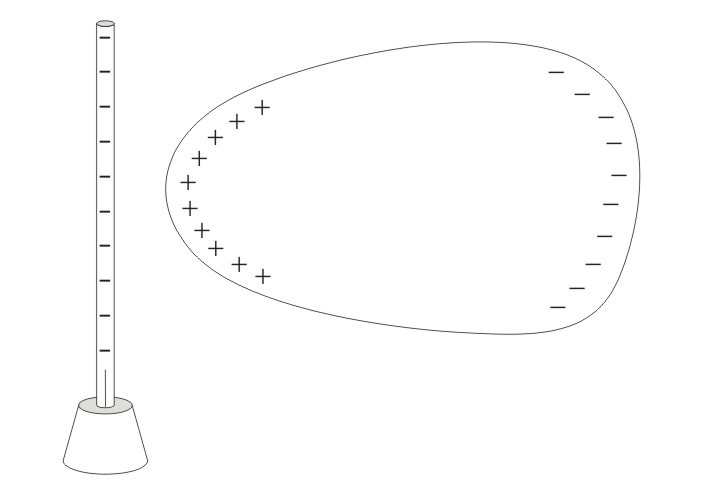
In a conductor, electric charges are free to flow across the surface of the body; as a result, the polarization of a conductor takes place at a macroscopic scale. Here is a diagram of an idealized polarized conductor with a negatively charged straw placed next to it. Positive charges accumulate close to the straw, while negative charges accumulate as far as possible from the straw.
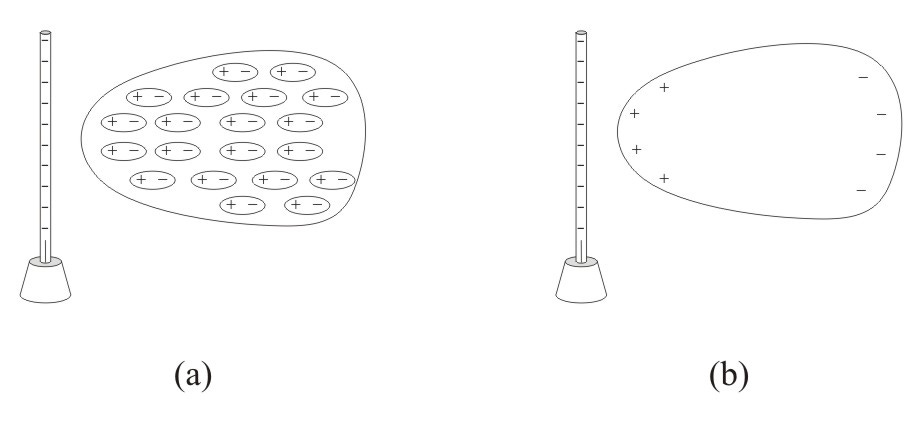
In a insulator, electric charges are not free to flow across the surface of the body; as a result, there is only polarization of the molecules within the body at a microscopic scale. This is illustrated in part (a) of the diagram below. The effective polarization of the whole body is shown in part (b). Note that the effective polarization is much less for the insulating plastic disk than for the conducting cardboard disk.
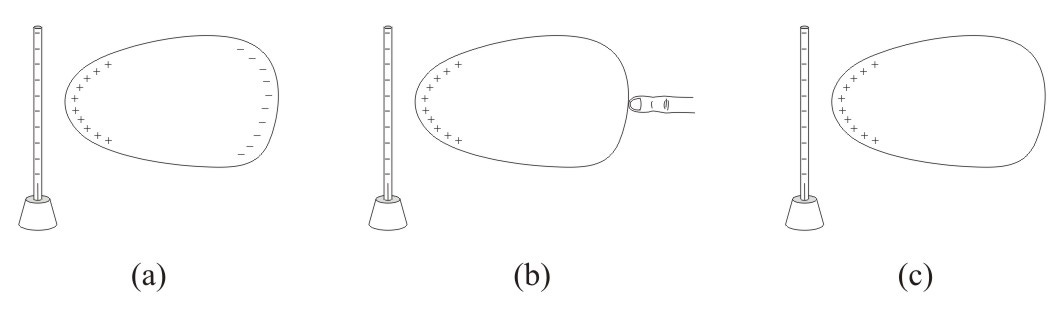
Once this difference between conductors and insulators is understood, then we can undertake a number of interesting experiments with conductors. For example, in the next diagram, a negatively charged plastic draw induces electric polarization in a conductor in part (a): the part of the conductor next to the straw is positively charged, while the far part is negatively charged. Subsequently, in part (b), the positively charged part of the conductor is touched with a finger, which will discharge the negatively charged part, while the part next to the straw will remain positively charged. Once the finger is removed, as in part (c), the conductor does not change.
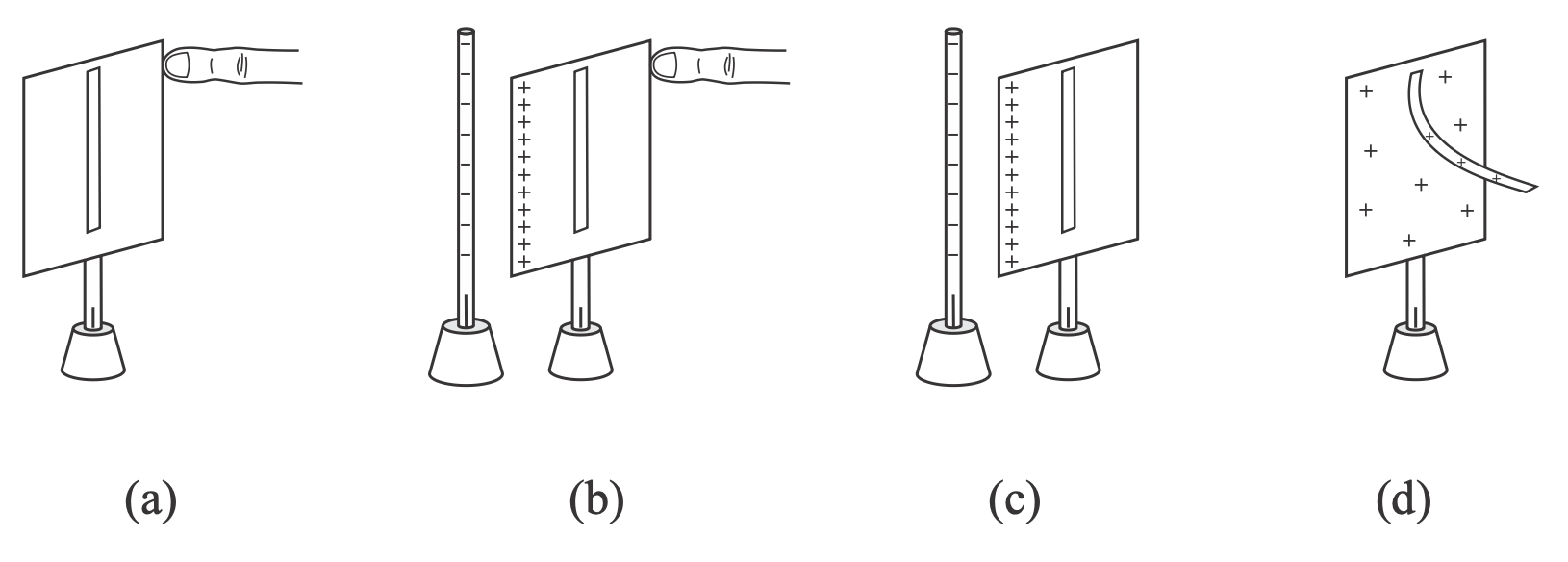
In the next diagram, in part (a), a finger is used to ground an electroscope at the beginning of the experiment. In part (b), a negatively charged straw is placed next to the electroscope, and polarization of the cardboard of the electroscope takes place: next to the straw, the cardboard becomes positively charged; and the far part of the cardboard remains neutral, as the finger continually discharges any accumulating negative charges. In parts (c) and (d), when the finger is removed, the positive charges move across the cardboard, making the entire cardboard positively charged, as does the little strip, which then rises, being repelled from the cardboard.
The descriptions above are of idealized conductors and of idealized insulators. Of course, as presented in the third post above, the same body can act as a conductor under some external conditions and as an insulator under other external conditions. So we can imagine real bodies, when subject to electric polarization, will combine a mix of macroscopic polarization and microscopic polarization. As always, in the real world and when conducting real experiments, whether at home or in sophisticated laboratories, the charging of different parts of a body need to be studied carefully before one can access how exactly electric charges may have moved during steps of the experiments.
If you wish to donate to support my work, please use the Buy Me a Coffee app.
Andre Koch Torres Assis. The Experimental and Historical Foundations of Electricity. Montreal: Apeiron. Volume 1: 2010. Volume 2: 2018.